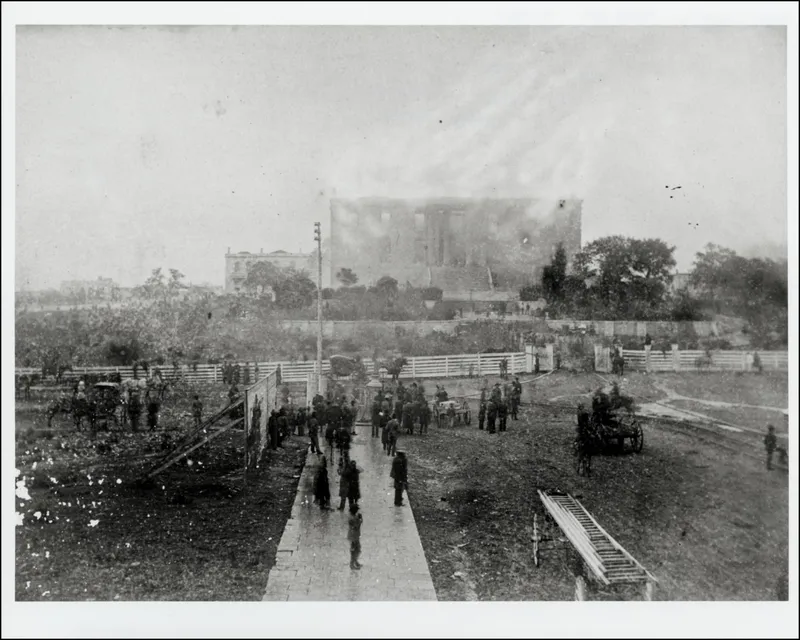
On a grey, chilly Wednesday in Austin – November 9, 1881 – disaster struck the heart of Texas government. Around noon, a fire erupted in the old limestone State Capitol building, just two blocks from Millett’s Opera House. What began as a wisp of smoke quickly grew into an inferno. Flames leapt from the walls and engulfed the two-story Capitol with alarming speed, feeding on the building’s woodwork and records. Austin’s volunteer firemen raced to the scene, bells clanging, but low water pressure and inadequate hydrants hampered their efforts. Within two hours, the proud Capitol was reduced to a blackened shell of smoldering limestone walls.
Figure Above: The old Texas State Capitol building ablaze on November 9, 1881. Volunteer firemen and astonished onlookers could only watch as flames consumed the “architectural monstrosity” atop Capitol Hill.
As the Capitol’s dome collapsed in a roar and smoke darkened the sky, witnesses described the scene in vivid terms. “The fire’s demon cruel tongues licked the fair proportions of the historic pile, while huge volumes of black smoke poured from the doomed building,” reported the Texas Siftings newspaper, “settling over the fair city… as the old sarcophagus crumbled.” Important archives and artifacts dating back to the Republic of Texas were lost in the blaze. Miraculously, no lives were reported lost – but Austin suddenly faced a crisis: with their Capitol in ruins, where would the state legislature and officials conduct business?
“The Temporary Capitol” – Millett’s Opera House to the Rescue
City leaders didn’t have to look far. Just two blocks away stood Millett’s Opera House, a grand limestone theater built in 1878 by Captain Charles F. Millett – a prominent local businessman and Austin’s first fire chief. The opera house was one of the largest auditoriums in Texas, boasting 800 seats, sturdy 24-inch limestone walls, a balcony and stage. In Austin’s hour of need, this privately-owned venue opened its doors to become an emergency capitol. Within weeks, state government moved into Millett’s Opera House, earning it the enduring nickname “The Temporary Capitol.” Legislators convened under its hand-painted proscenium arch – the Texas House of Representatives even held a special session of the 17th Legislature there in early 1882 (the Senate met in a nearby hall).
What normally hosted operas, plays, and social galas suddenly hosted the grind of governance: debates, lawmaking, and official meetings filled the opera stage. Austin’s social center had become the literal seat of Texas government overnight.
For several years, Millett’s Opera House served as a makeshift Capitol while the state rebuilt. The press and public recognized the irony and significance: a private theater – built by a man dedicated to civic life (Millett had also served as city alderman and fire volunteer) – was now the guardian of Texas government. This episode underscored how important the opera house was as a public gathering place. One could imagine the mix of sights and sounds: finely dressed officials huddled in debate by day, where by night the same stage might host a touring opera or a local graduation ceremony. In fact, the opera house had always been a community hub – it hosted everything from church services to political conventions and concerts. Now, it literally kept the wheels of government turning.
Legacy of the Capitol Fire and Opera House’s Heroic Role
The 1881 Capitol fire proved to be a turning point in Texas history. It hastened plans to build a new, grander Capitol of red granite (completed in 1888). A temporary Capitol building of wood was also quickly erected at 11th and Congress by 1882 to more fully house state offices. Yet, throughout this interim period, Millett’s Opera House remained an invaluable standby venue for the state. Its role as “Temporary Capitol” is remembered as a point of pride in Austin’s heritage. The opera house’s very design and size – once intended to civilize a frontier city with culture – ended up saving the day in a civic emergency.
Captain Charles F. Millett, who had built the opera house, could hardly have imagined that his theater would host the government of Texas. (Perhaps his background as a fire chief made him uniquely prepared to help in a fire crisis!) The fact that Millett’s Opera House stood ready when the flames came is a testament to how robust and versatile the venue was. “The Opera House had programs ranging from medicine shows to legislative sessions while the new Capitol was being constructed,” notes one history[10]. This extraordinary chapter earned the building a permanent place in Texas lore.
A historic marker now stands at Ninth Street, and today the beautifully preserved structure – home of the Austin Club – still exudes the elegance of its opera house days, its thick limestone walls bearing silent witness to the dramatic events of 1881.
In the end, what could have been an even greater catastrophe was met with resilience and community spirit. Millett’s Opera House became more than just an entertainment venue; it became a symbol of Austin’s ability to improvise and persevere. As the old Capitol’s embers cooled, the “Temporary Capitol” at the opera house buzzed with activity, ensuring continuity of governance. This remarkable partnership of public need and private resource highlights a proud moment in our city’s history – one we continue to celebrate as we keep the legend of Captain Millett and his Opera House alive for future generations.