The Millett Opera House Foundation is dedicated to the preservation, restoration, interpretation, and future stewardship of Austin’s historic 1878 Millett Opera House — home of The Austin Club and one of the city’s most important surviving landmarks.
On This Day in Millett Opera House History

On This Day in Millett Opera House History

December 10, 1879 – The Night the Wild West Stormed the Stage

Dear Members,

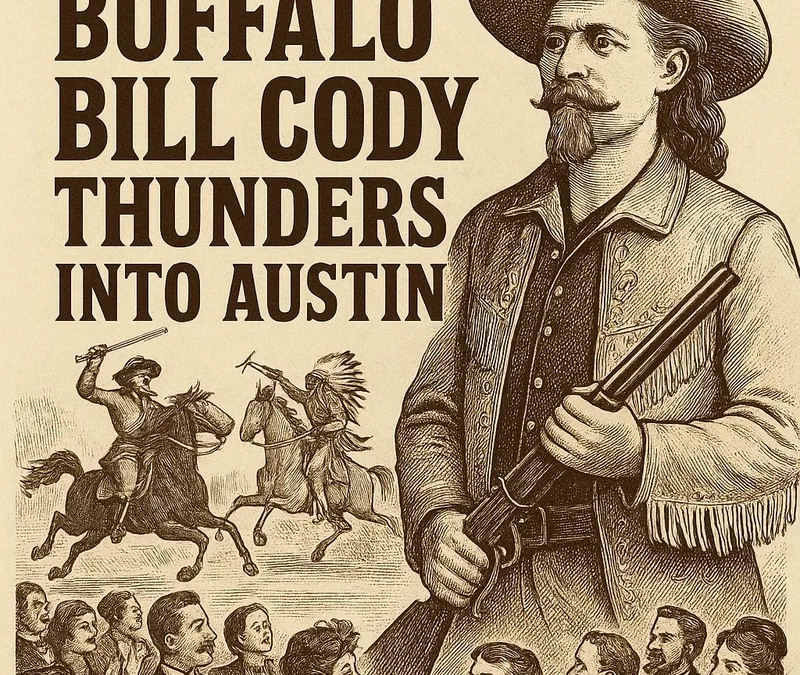
Had you walked into the Millett Opera House on the evening of December 10, 1879, you might have wondered whether you’d entered a theater—or stepped straight into the American frontier. Gaslights flickered. Excitement hummed through the crowd. And backstage, preparing to stride into the glow of the footlights, stood a man already becoming a legend: William F. “Buffalo Bill” Cody.

Austin had never seen anything like what was about to unfold.

A Frontier Legend Arrives in Austin

Buffalo Bill arrived in town as a national sensation. At just 33 years old, he had already been a U.S. Army scout, a buffalo hunter, a Pony Express rider, and the subject of countless dime novels. His tall frame, buckskin coat, flowing hair, and confident smile made him instantly recognizable wherever he traveled.

But Austin wasn’t just getting a celebrity appearance—it was receiving a full theatrical experience. Cody brought with him “Scouts of the Plains,” a melodramatic retelling of his own adventures, complete with frontier drama, daring stunts, and a cast that included real Native American performers in traditional regalia. For three nights, beginning December 8, he and his troupe would transform Millett’s Opera House into a living, breathing Wild West arena. The December 10 performance would be the climax of their stay.

As the curtain rose, the genteel elegance of the opera house gave way to the raw energy of the frontier. Cowboys in fringed leather strode across the stage. Sioux and Pawnee performers reenacted dances and battle scenes that electrified the crowd. The shouts, the whoops, the thunder of mock gunfire—all echoed against the limestone walls Captain Millett had raised just two years earlier.

One moment above all left the audience breathless. In a feat so daring it bordered on reckless, one of Cody’s sharpshooters took aim at a small target balanced on a young woman’s head. With a crack of the rifle, the marksman shot a pear cleanly off her crown without so much as grazing her. Even in an era accustomed to rough entertainment, the stunt sent murmurs rippling through the theater. The audience was on its feet.

But the show on stage was only part of the story. The day before the final performance, December 9, Buffalo Bill rode out with a local celebrity—Ben Thompson, Austin’s notorious gunfighter and city marshal. The two men, both larger-than-life figures, took turns firing at coins tossed into the air. Newspapers later reported that Cody hit six out of seven half-dollars mid-flight, a feat that stunned the small crowd of onlookers.

The next morning’s Austin Statesman was almost breathless in its praise, declaring Cody “one of the best marksmen on the American continent” and calling his shooting “perfectly marvelous.” The publicity only heightened the anticipation for the December 10 show. By the time Cody stepped onto the stage for the final curtain call, the opera house roared with excitement. Austin had fallen under the spell of the Wild West.

In the years that followed, Buffalo Bill would launch “Buffalo Bill’s Wild West,” a traveling spectacle that would captivate the world, tour Europe, meet royalty, and define America’s image of the frontier for generations.

But on that December night in 1879, Austin experienced something rare and intimate: Buffalo Bill Cody before he became an icon, performing not in a vast arena, but beneath the hand-painted ceiling of the Millett Opera House.

For many in the audience, it was likely the first time they had seen Native American performers, cowboy trick riding, or sharpshooting of such skill. And the sight of it all unfolding in a theater built to civilize a frontier town added an irony not lost on the citizens of Austin. Culture and wilderness met on the same stage, and both left their mark.

The Millett Opera House has hosted opera stars, dignitaries, politicians, scholars, and artists—but few nights were as unforgettable as December 10, 1879. The performance encapsulated the very spirit of Austin at the time: a city caught between refinement and frontier grit, eager to embrace both.

Today, as members of The Austin Club, you gather in the same rooms where Buffalo Bill walked, where Native performers danced, where gaslights glowed on an audience swept up in the thrill of the unknown. The echoes of that night still linger within the limestone, a reminder that this building has always been more than stone and mortar—it is a living chronicle of the American story.

And on this day, we remember the evening the Wild West thundered into Austin and left its mark on the Millett Opera House forever.
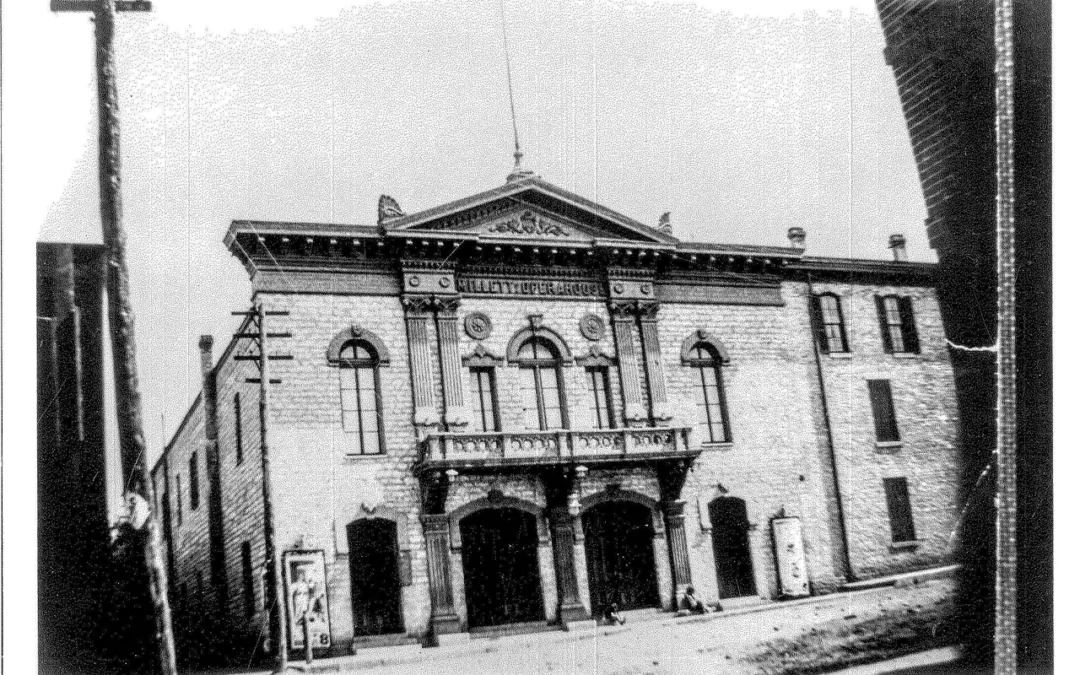
Opening Night at the Millett Opera House – October 28, 1878

Opening Night at the Millett Opera House – October 28, 1878

Opening Night at the Millett Opera House (Oct. 28, 1878): Austin’s brand-new Millett Opera House debuted its first theatrical performance on the evening of October 28, 1878. The inaugural show was My Awful Dad, a popular two-act comedy starring John Dillon, an internationally acclaimed comedic actor of the era. Dillon led a full company of supporting players accompanied by Max Ferhmann’s orchestra, ensuring the new theater opened with much fanfare and professional polish. This date effectively became the Opera House’s true grand opening – a previously scheduled amateur benefit performance on October 23 (the play Coquette) had apparently been postponed, making Dillon’s engagement the venue’s first public show.

Audience Reception and Public Reaction

Audience Reception and Public Reaction: Austinites greeted the opening night with tremendous enthusiasm. By 1878 the city’s population had grown above 11,000, and there was widespread civic pride and excitement for Austin’s first “true” theater venue. The Millett Opera House was the largest entertainment hall in town – Texas’ second-largest opera house at the time – boasting roughly 800 seats in its orchestra and gallery sections. Not surprisingly, the premiere drew a full house of curious theatergoers, including many of Austin’s leading citizens. Contemporary accounts describe an animated, standing-room-only crowd. Local newspapers (such as the Austin Statesman) praised the Opera House’s elegant design and reported that Dillon’s comic performance kept the audience rolling with laughter throughout the evening. Though specific reviews are scarce, by all indications the opening was a rousing success – My Awful Dad elicited hearty applause, and the venue’s acoustics and comforts were well received by the public.

Press Coverage and Notable Attendees

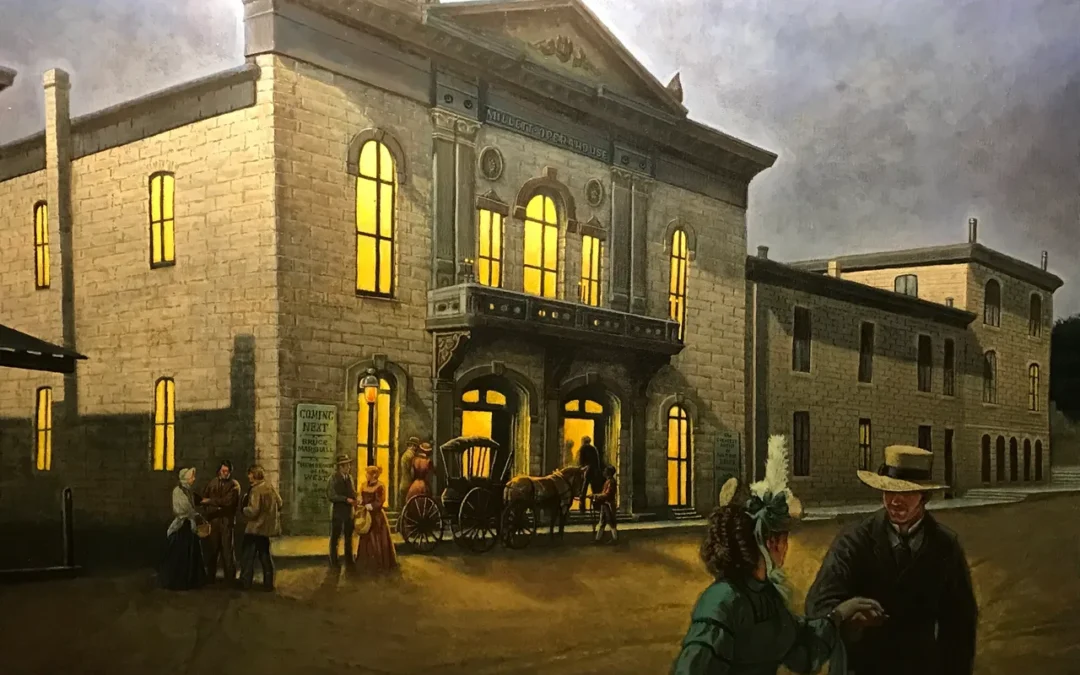
Press Coverage and Notable Attendees: The Austin press marked the event as a milestone in the city’s cultural life. In the days surrounding the opening, the Statesman and other papers ran notices highlighting the Opera House’s debut. (Construction of the hall had been followed closely in the press – local papers gave frequent updates, reflecting how eagerly the community anticipated a first-class theater.) While we lack a full transcript of the opening night review, the Statesman and other journals lauded John Dillon’s acting credentials and welcomed the arrival of “first-class amusements” to Austin. It was noted that many dignitaries were in attendance – city officials, businessmen, and society families turned out in force, treating the premiere as a major social occasion. It’s likely that Governor Richard Hubbard (in office in 1878) or other prominent Texans were among the audience, though specific attendee lists are not recorded in surviving sources. The scene that night was described as “brilliant” – ladies and gentlemen in their finest attire filled the limestone hall, and arriving carriages lined Ash Street (East 9th Street) outside[7]. For Austin’s citizenry, the Opera House’s opening symbolized the city’s emergence as a cultured capital.

Ticket Prices and Program Details

Ticket Prices and Program Details: Tickets for My Awful Dad were sold to the public in advance. Advertisements in late October 1878 (likely in the Weekly Democratic Statesman) announced the show. Although exact opening-night ticket prices are not preserved in print, typical theater rates of the period suggest that reserved parquet seats were about $1.00, with gallery admission around 50¢ – a modest sum that still put the night’s entertainment within reach of the middle class. The evening’s program featured Dillon in the lead role of Adonis Evergreen (the blundering “awful dad” of the farce, originally penned by British playwright Charles Mathews) supported by a full cast. Between acts, Max Ferhmann’s orchestra – a popular local ensemble – performed lively musical interludes. The combination of a known star comedian, a humorous play, and live orchestra made for a novel treat in post-Reconstruction Austin. Newspapers noted that the theater’s gas lighting and ventilation held up well, though some playfully remarked on the “scent of gas” and warmth inside from the packed crowd. On the whole, however, the comfort and scale of the new venue impressed attendees.

Cultural Atmosphere in 1878 Austin

Cultural Atmosphere in 1878 Austin: The successful opening of the Millett Opera House spoke to Austin’s growing cultural ambitions in the late 1870s. Until then, the capital had lacked a dedicated large theater; traveling shows often performed in improvised venues. The Opera House’s completion “finally realized” Austinites’ long-held wish for a proper theater. Built by entrepreneur Charles F. Millett (a local lumber magnate and former fire chief) at 9th and Congress, the imposing limestone hall immediately became the social hotspot in town. As one account notes, upon its opening the Millett Opera House was “the largest entertainment venue in Austin”, second in size only to Galveston’s opera house statewide[5]. Its stage and seating capacity allowed Austin to attract the kind of touring productions and famous performers that previously bypassed the city. Indeed, the joyous public response on opening night was just a start – in the months and years that followed, the Opera House hosted Shakespearean tragedians like Edwin Booth, diva Lillie Langtry, composer John Philip Sousa’s band, and many other luminaries. But it was the rousing reception of that first show, My Awful Dad, that proved Austinites were eager to support the performing arts. The Austin Statesman crowed that the Opera House’s debut signaled Austin’s arrival as a cultured city, no longer a “frontier town” but a community ready for high-class entertainment. Residents continued to reminisce fondly about the opening night for years – the laughter echoing in the hall, the sight of a packed audience under the gaslight, and the sense that Austin’s civic identity had been immeasurably enriched by that evening.

Legacy of Opening Night

Legacy of Opening Night: In retrospect, October 28, 1878 stands as a landmark date in Austin’s cultural history. The Millett Opera House’s inaugural performance was not only an immediate triumph but also paved the way for a thriving local theatre scene. My Awful Dad remained in the city’s collective memory as the play that launched an era of grand performances in Austin. The Opera House would serve as a venue for everything from church services and high school graduations to legislative sessions during Capitol construction, but its core identity as Austin’s premier stage was established from that very first night. The press coverage and diary accounts uniformly convey that opening night was a “brilliant success” – one that drew “an overflowing house and unbounded applause” (in the words of a later historian). For the people of Austin in 1878, the laughter and cheers ringing through the Millett Opera House on opening night heralded a new cultural age for the city.

November 9, 1881 – The Texas Capitol Burns, and Millett’s Opera House Rises to the Occasion

November 9, 1881 – The Texas Capitol Burns, and Millett’s Opera House Rises to the Occasion

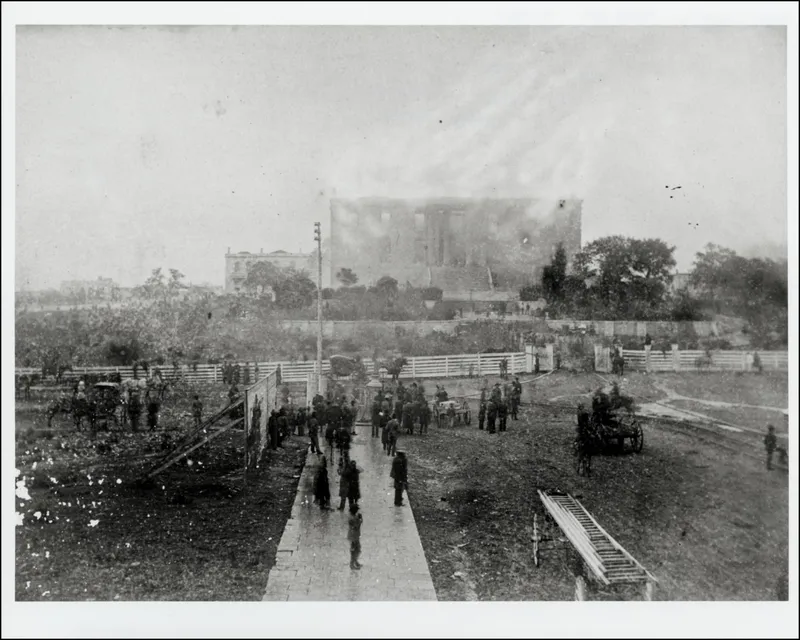
On a grey, chilly Wednesday in Austin – November 9, 1881 – disaster struck the heart of Texas government. Around noon, a fire erupted in the old limestone State Capitol building, just two blocks from Millett’s Opera House. What began as a wisp of smoke quickly grew into an inferno. Flames leapt from the walls and engulfed the two-story Capitol with alarming speed, feeding on the building’s woodwork and records. Austin’s volunteer firemen raced to the scene, bells clanging, but low water pressure and inadequate hydrants hampered their efforts. Within two hours, the proud Capitol was reduced to a blackened shell of smoldering limestone walls.

Figure Above: The old Texas State Capitol building ablaze on November 9, 1881. Volunteer firemen and astonished onlookers could only watch as flames consumed the “architectural monstrosity” atop Capitol Hill.

As the Capitol’s dome collapsed in a roar and smoke darkened the sky, witnesses described the scene in vivid terms. “The fire’s demon cruel tongues licked the fair proportions of the historic pile, while huge volumes of black smoke poured from the doomed building,” reported the Texas Siftings newspaper, “settling over the fair city… as the old sarcophagus crumbled.” Important archives and artifacts dating back to the Republic of Texas were lost in the blaze. Miraculously, no lives were reported lost – but Austin suddenly faced a crisis: with their Capitol in ruins, where would the state legislature and officials conduct business?

“The Temporary Capitol” – Millett’s Opera House to the Rescue

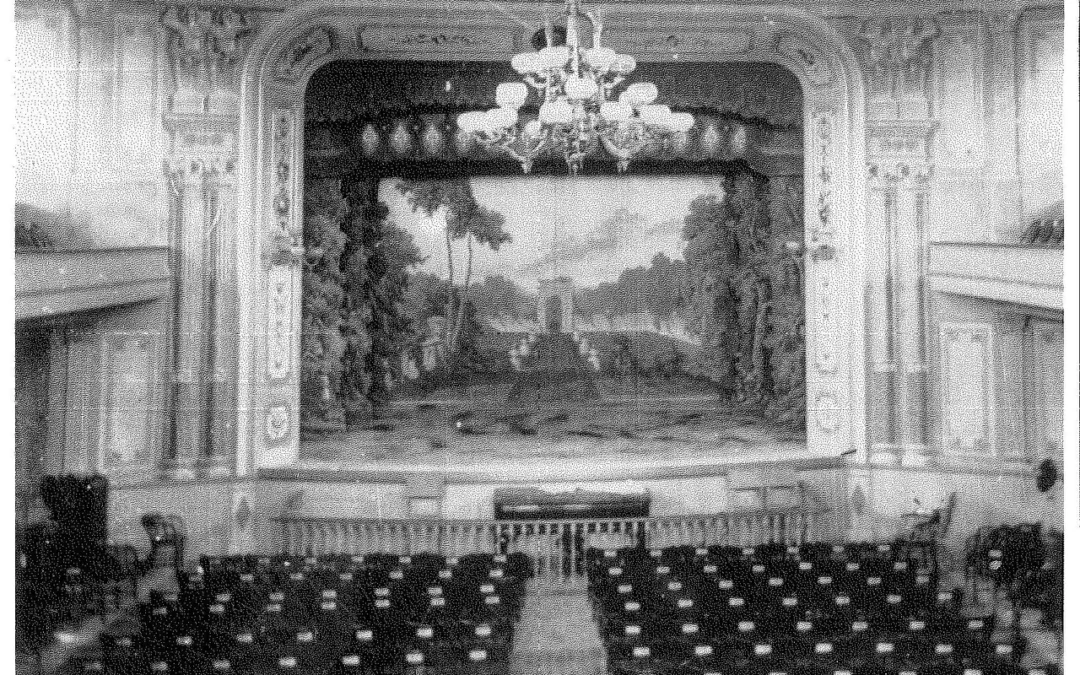
City leaders didn’t have to look far. Just two blocks away stood Millett’s Opera House, a grand limestone theater built in 1878 by Captain Charles F. Millett – a prominent local businessman and Austin’s first fire chief. The opera house was one of the largest auditoriums in Texas, boasting 800 seats, sturdy 24-inch limestone walls, a balcony and stage. In Austin’s hour of need, this privately-owned venue opened its doors to become an emergency capitol. Within weeks, state government moved into Millett’s Opera House, earning it the enduring nickname “The Temporary Capitol.” Legislators convened under its hand-painted proscenium arch – the Texas House of Representatives even held a special session of the 17th Legislature there in early 1882 (the Senate met in a nearby hall).

What normally hosted operas, plays, and social galas suddenly hosted the grind of governance: debates, lawmaking, and official meetings filled the opera stage. Austin’s social center had become the literal seat of Texas government overnight.

For several years, Millett’s Opera House served as a makeshift Capitol while the state rebuilt. The press and public recognized the irony and significance: a private theater – built by a man dedicated to civic life (Millett had also served as city alderman and fire volunteer) – was now the guardian of Texas government. This episode underscored how important the opera house was as a public gathering place. One could imagine the mix of sights and sounds: finely dressed officials huddled in debate by day, where by night the same stage might host a touring opera or a local graduation ceremony. In fact, the opera house had always been a community hub – it hosted everything from church services to political conventions and concerts. Now, it literally kept the wheels of government turning.

Legacy of the Capitol Fire and Opera House’s Heroic Role

The 1881 Capitol fire proved to be a turning point in Texas history. It hastened plans to build a new, grander Capitol of red granite (completed in 1888). A temporary Capitol building of wood was also quickly erected at 11th and Congress by 1882 to more fully house state offices. Yet, throughout this interim period, Millett’s Opera House remained an invaluable standby venue for the state. Its role as “Temporary Capitol” is remembered as a point of pride in Austin’s heritage. The opera house’s very design and size – once intended to civilize a frontier city with culture – ended up saving the day in a civic emergency.

Captain Charles F. Millett, who had built the opera house, could hardly have imagined that his theater would host the government of Texas. (Perhaps his background as a fire chief made him uniquely prepared to help in a fire crisis!) The fact that Millett’s Opera House stood ready when the flames came is a testament to how robust and versatile the venue was. “The Opera House had programs ranging from medicine shows to legislative sessions while the new Capitol was being constructed,” notes one history[10]. This extraordinary chapter earned the building a permanent place in Texas lore.

A historic marker now stands at Ninth Street, and today the beautifully preserved structure – home of the Austin Club – still exudes the elegance of its opera house days, its thick limestone walls bearing silent witness to the dramatic events of 1881.

In the end, what could have been an even greater catastrophe was met with resilience and community spirit. Millett’s Opera House became more than just an entertainment venue; it became a symbol of Austin’s ability to improvise and persevere. As the old Capitol’s embers cooled, the “Temporary Capitol” at the opera house buzzed with activity, ensuring continuity of governance. This remarkable partnership of public need and private resource highlights a proud moment in our city’s history – one we continue to celebrate as we keep the legend of Captain Millett and his Opera House alive for future generations.

History of The Austin Club

History of The Austin Club

A Celebration of 70 Spectacular Years©

Austin Club #1 – 104 E. 4th St. 1890-1982

Chartered December 31, 1899, The Austin Club began operating April 25, 1890 in the not then completed Austin Board of Trade building at the northeast corner of Congress Avenue and East 4th Street with the following headline and description of its lavish interiors appearing in the Austin Statesman:

THE AUSTIN CLUB: Their luxurious and sumptuously appointed quarters opened last night.

Oriental Loveliness and Tranquilizing Effects To Please the Senses to be Found In Their Elegant Social Home

THE CLUB HOME

…….Entrance to the club rooms is gained on Fourth Street. A broad stairway with easy ascent and rests leads to the second floor in the Board of Trade building on which the rooms are located. They are separated from the rear half of the building by a spacious hall, and to gain admission you pass through a beautiful double door ornamented with colored and frosted cut glass on which is the monogram of the club. This door lets you into a large hall on the right of which as you enter is the store room, bar, wine and lunch room all appropriately arranged and furnished. The bar is well appointed with handsome sideboards and elegant cut glassware bearing the monogram of the club. Further on and adjoining the wine room is the card room which is supplied with the necessary paraphernalia necessary to make such a apartment both pleasant and comfortable. Across the room from the wine and card room is the billiard hall in which there are a billiard and a pool table with one pool table yet to be put in. The billiard hall is 24 by 54 feet and is most agreeably fitted up. From the billiard hall you enter the gentlemen’s reading room and library. This room is elegantly furnished with hand carved furniture and stamped leather. In this there is a large table, two desks, library sitting and easy chairs and settees. The window draperies are elegant in plush and lace, in old gold and maroon, and in the sheen of brilliant electric lights last night were lovely. From this room you enter the parlor through an immense arched way pendant from which are elaborate portieres and elegant draperies. The parlor is the most sumptuously furnished room in the city. The furniture is unique in design and the upholstery is in the highest style known to the trade. The window furnishings are most elaborate and the arrangement of the room is of that soft oriental loveliness that will commend it to the refined tastes of all lovers of the beautiful. The elegance of the draperies, the happy blending of their colors, their graceful groupings and wondrous effects are due to Mr. Ph. Hatzfeld and Mr. Charles L. Condit who arranged them with “the science of the perception of beauty”. The carpet in this room and the reading room is a costly moquette of most beautiful pattern. The parlor is furnished with an elegant piano, pictures and other decorations. Over the entrance leading from the parlor to the hall is an elegantly wrought Japanese portiere and it adds much to the chaste beauty of the decorations. The parlor and reading room have wainscoting in old gold and green bronze and frieze of the same. The hall and card rooms are all carpeted with handsome moquette of elegant designs. The tinting of all the rooms is old rose.

The building is supplied with electric bells and washroom and in all the State there is not a more elegant and comfortable club room.

*Win a prize: Be the first to e-mail Brittany (brittany@austinclub.com) where The Austin Club moved in 1892.

*You must be a member of The Austin Club in good standing to win.

For more information about the HISTORY OF THE AUSTIN CLUB©: A CELEBRATION OF 70 SPECTACULAR YEARS or to reserve a copy please e-mail brittany@austinclub.com

iiTHE HISTORY OF THE AUSTIN CLUB- A Celebration of 70 Spectacular Years at page X, by Laura Fowler and Kenneth C. Richardson, 2019

St. Valentine’s Week

St. Valentine’s Week

Dear Readers:

Some of you asked me to provide a few thoughts last year for your 140th Anniversary of the Grand Opening of the Millett’s Opera House last October. I really enjoyed that anniversary party. So sorry I could not appear in person. I am sure you understand my current limitations.

At your request, I have agreed to share each month- at least until you tell me to stop! – one or more amazing events that happened in or around Millett’s Opera House 140 years ago. This is a lot of fun for me. The only hard part is trying to choose among the many spectacular events. The first Austin appearance by acclaimed Shakespearean actors Frederick Warde, Edward Booth and Helen Modjeska ,the first appearance of Buffalo Bill and his Band of Genuine Indian Chiefs, who shot a pear off a lady’s head on the stage—frankly that one worried me a little-to the first ever graduation ceremonies of the University of Texas, when thirteen (13) young men received a baccalaureate of law while the entire University of Texas student body of two hundred (200) applauded.

If you know of anything that happened at Millett’s Opera House, share it with us at our brand-new website. In your every adventure at Millett’s Opera House I wish you every success.

Many of you reading this have attended live theatre in Austin. Austin now has an abundance of beautiful performing arts venues all over our very large city. But in 1878 when Millett’s Opera House opened its doors, it was the only one respectable and large enough to attract top artists.

Have you ever thought about how difficult it is to organize a performance, arrange for the artists, advertise repeatedly, schedule the performing arts venue and make it ready for the unique needs of the artists? That’s a lot of work even today.

Think about what I had to do to arrange for performers. From the very beginning, I did succeed in inviting some of the most famous stars of the stage, many of them internationally acclaimed. Shakespeare, Grand Opera, Comic Opera, Vaudeville, even Burlesque, when the Austin Daily Statesmen reporters let me get away with it. We often packed the house. Millett’s was supposed to only sell tickets to 800 patrons on the main floor and another 400 in the balconies and galleries, but I confess, attendance often was many more than 1,200, due to the enormous popularity of some performers or the significance of the event.

My only means to communicate with all these performers was by telegraph, private correspondence or postal mail. I didn’t even have a telephone and these other methods were not reliable all of the time. Mostly we booked touring companies, usually suggesting they add Millett’s Opera House to a tour that included performances in New Orleans, Galveston and San Antonio or Dallas. Those ten (10) hour train rides from Galveston left them pretty weary when they arrived in Austin, even if they had their own private railway cars, which many of them did.

I would arrange for horse drawn wagons and carriages to meet the performing troupes at the brand new International & Great Northern Railroad Depot at the southwest corner of Congress Avenue and Cypress (West 3rd) Street.

My teams and I would help unload all the artists, supporting company members who frequently were a hundred or more, large pieces of unique portable stage scenery and props and musical instruments which were taken off the train and reloaded onto wagons and carriages. Then we drove everyone and everything up Congress Avenue to Millett’s Opera House and the various hotels where they were to stay. We would unload all their things again. This took many hours when they arrived, and hours when they departed.

To attract celebrated performers to Austin and to the Millett’s Opera House, we had to give them an opportunity to perform multiple times so they could make justify the trip. Railway travel was prohibitively expensive for many. Our programs were ambitious.

The evenings of February 13, 14th and 15th, ,1879, plus a Saturday Matinee, Millett’s Opera House featured the dramatic actress Louise Pomeroy plus her company, in those days called a combination, who performed Adirondacks, Camille, and Shakespeare’s As You Like It. Miss Pomeroy and her friends left and by Monday next, Jennie Hughes, and her Vaudeville company had arrived for a two-night engagement of New French Spy. Anything with the word “French” in it sold well in those days, even if the very conservative reporters at the Austin Daily Statesman were not amused.

I always liked St. Valentine’s Day a lot. Attendance at our performances was excellent, all those young men bringing their sweethearts to see a romantic comedy or play. So, I share with you the following around St. Valentine’s Day in 1879, to give you an idea of what it was like, 140 Years Ago at Millett’s Opera House®.

Look what the Austin Daily Statesman said about these amazing women and their performances:

AUSTIN DAILY STATESMAN

February 11, 1879

Mrs. Louise Pomeroy, the actress to appear at the Opera House on the 13th, is a divorced wife of Brick Pomeroy. Brick Pomeroy lectured to a full house in this city a few years ago.

February 12, 1879

All levers of the Drama will be pleased to learn that Miss Pomeroy has recovered sufficiently from injuries sustained in the recent disastrous railroad accident to appear on the stage at Millett’s Opera House.

February 14, 1879

The Adirondack’s

Miss Louise Pomeroy supported by Jos. Edwards N.Y. Combination delighted the Austin people last night at the opera house…. Miss Pomeroy, now but twenty-eight years old of tall and commanding figure, and a woman of rare personal charm. She is a blonde and in her rich lavender suit she looked sweet enough to capture the heart of an editor or “any other man” ….

Well, even if that Austin Daily Statesman editor fell madly in love with Miss Pomeroy on St. Valentine’s Day, at the United States Post Office just down the block at Brazos and Bois d’Arc (E.7th) Street, things weren’t nearly as sweet:

February 15, 1879

A great many people went to the post office yesterday. Old ladies and young ladies, gray haired men and little girls and boys were in the procession that pranced into the post office and then solemnly marched out again. It was Valentine’s Day and the post office did an immense but not very profitable business. To hand out five cent valentines to five thousand people for five mortal hours is enough to sour the temper of the sweetest mortal living…It’s worse and more heating than working in a steam laundry in July or praying by the yard for a Texas legislature.

Even ever everyone in Austin did not get a valentine, a whole lot of them turned out the next two nights to see and hear the vaudeville performer Jennie Hughes:

February 18, 1879

At The Opera House

A fine house greeted the performance of Miss Jennie Hughes in The French Spy. The applause was constant and enthusiastic throughout. The second part of the programme was devoted to the production of “The French Spy” with Miss Jennie Hughes in the title role. The lady is not only blessed with a very prepossessing appearance, but is an excellent pantomimist. She plays with spirit and is an artist in picturesque posing. The combat scene between Hamet and Mohammed is the best scene of its kind ever witnessed in Austin……Tonight there will be a an entire change of programme, introducing Miss Hughes in a speaking part with her well known songs and dances including French, German and Spanish melodies.

See you next month.