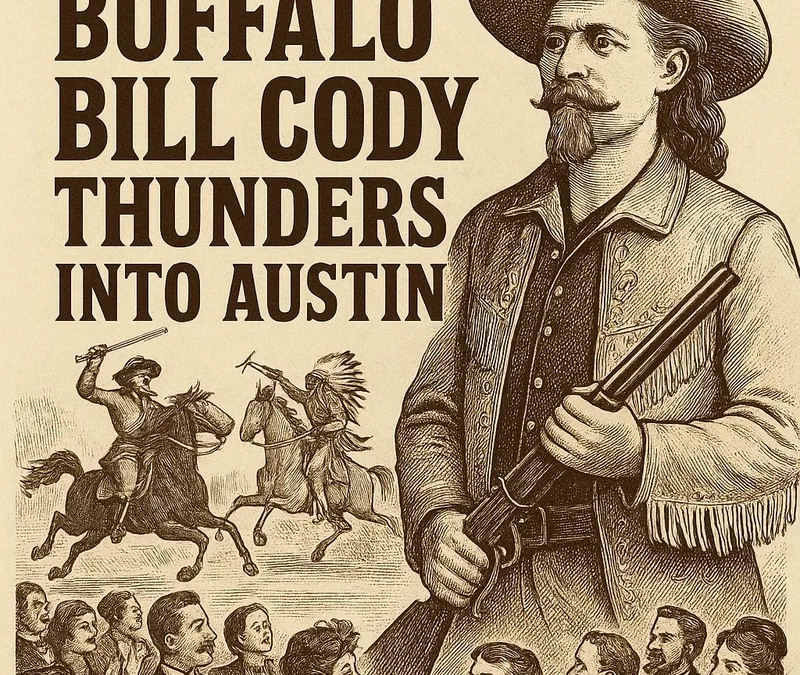
December 10, 1879 – The Night the Wild West Stormed the Stage
Dear Members,
Had you walked into the Millett Opera House on the evening of December 10, 1879, you might have wondered whether you’d entered a theater—or stepped straight into the American frontier. Gaslights flickered. Excitement hummed through the crowd. And backstage, preparing to stride into the glow of the footlights, stood a man already becoming a legend: William F. “Buffalo Bill” Cody.
Austin had never seen anything like what was about to unfold.
A Frontier Legend Arrives in Austin
Buffalo Bill arrived in town as a national sensation. At just 33 years old, he had already been a U.S. Army scout, a buffalo hunter, a Pony Express rider, and the subject of countless dime novels. His tall frame, buckskin coat, flowing hair, and confident smile made him instantly recognizable wherever he traveled.
But Austin wasn’t just getting a celebrity appearance—it was receiving a full theatrical experience. Cody brought with him “Scouts of the Plains,” a melodramatic retelling of his own adventures, complete with frontier drama, daring stunts, and a cast that included real Native American performers in traditional regalia. For three nights, beginning December 8, he and his troupe would transform Millett’s Opera House into a living, breathing Wild West arena. The December 10 performance would be the climax of their stay.
As the curtain rose, the genteel elegance of the opera house gave way to the raw energy of the frontier. Cowboys in fringed leather strode across the stage. Sioux and Pawnee performers reenacted dances and battle scenes that electrified the crowd. The shouts, the whoops, the thunder of mock gunfire—all echoed against the limestone walls Captain Millett had raised just two years earlier.
One moment above all left the audience breathless. In a feat so daring it bordered on reckless, one of Cody’s sharpshooters took aim at a small target balanced on a young woman’s head. With a crack of the rifle, the marksman shot a pear cleanly off her crown without so much as grazing her. Even in an era accustomed to rough entertainment, the stunt sent murmurs rippling through the theater. The audience was on its feet.
But the show on stage was only part of the story. The day before the final performance, December 9, Buffalo Bill rode out with a local celebrity—Ben Thompson, Austin’s notorious gunfighter and city marshal. The two men, both larger-than-life figures, took turns firing at coins tossed into the air. Newspapers later reported that Cody hit six out of seven half-dollars mid-flight, a feat that stunned the small crowd of onlookers.
The next morning’s Austin Statesman was almost breathless in its praise, declaring Cody “one of the best marksmen on the American continent” and calling his shooting “perfectly marvelous.” The publicity only heightened the anticipation for the December 10 show. By the time Cody stepped onto the stage for the final curtain call, the opera house roared with excitement. Austin had fallen under the spell of the Wild West.
In the years that followed, Buffalo Bill would launch “Buffalo Bill’s Wild West,” a traveling spectacle that would captivate the world, tour Europe, meet royalty, and define America’s image of the frontier for generations.
But on that December night in 1879, Austin experienced something rare and intimate: Buffalo Bill Cody before he became an icon, performing not in a vast arena, but beneath the hand-painted ceiling of the Millett Opera House.
For many in the audience, it was likely the first time they had seen Native American performers, cowboy trick riding, or sharpshooting of such skill. And the sight of it all unfolding in a theater built to civilize a frontier town added an irony not lost on the citizens of Austin. Culture and wilderness met on the same stage, and both left their mark.
The Millett Opera House has hosted opera stars, dignitaries, politicians, scholars, and artists—but few nights were as unforgettable as December 10, 1879. The performance encapsulated the very spirit of Austin at the time: a city caught between refinement and frontier grit, eager to embrace both.
Today, as members of The Austin Club, you gather in the same rooms where Buffalo Bill walked, where Native performers danced, where gaslights glowed on an audience swept up in the thrill of the unknown. The echoes of that night still linger within the limestone, a reminder that this building has always been more than stone and mortar—it is a living chronicle of the American story.
And on this day, we remember the evening the Wild West thundered into Austin and left its mark on the Millett Opera House forever.